Physical Symptoms Of Sitting Too Much Sedentary Pains
- 1.
When Your Couch Becomes a Coffin: The Creepy Truth About Sedentary Life
- 2.
Legs on Lockdown: What Happens When You Park It for Too Long
- 3.
Muscle Mayhem: Which Body Parts Throw in the Towel First?
- 4.
Metabolic Misfires: How Couch Potato Mode Slows Your Engine
- 5.
Spine Betrayal: Why Your Back Hates Your Office Chair
- 6.
Mood Meltdowns and Mental Fog: The Hidden Emotional Toll
- 7.
Posture Pandemonium: From Slouch to “Who Even Am I?”
- 8.
Energy Drain: Why You’re Tired But Can’t Sleep
- 9.
Digestive Drama: Your Gut’s Silent Protest
- 10.
Breaking Free: Small Moves, Big Shifts Against Sedentary Harm
Table of Contents
physical symptoms of sitting too much
When Your Couch Becomes a Coffin: The Creepy Truth About Sedentary Life
Ever caught yourself muttering, “Dang, I’ve been parked in this chair longer than my truck’s been in the shop”? Same, friend. And nah—this ain’t just you bein’ lazy. It’s your body sendin’ smoke signals (or full-on flares) about the physical symptoms of sitting too much. We’ve all been deep in that Netflix vortex, trapped in back-to-back Zoom marathons, or just scrollin’ TikTok like it’s payin’ rent. But under that “I’m chillin’” vibe? Your hips are lockin’ up, your hamstrings are slacking harder than a cat in a sunbeam, and your spine’s pitchin’ a full-blown silent protest. And here’s the kicker—those physical symptoms of sitting too much don’t just ghost after a quick stretch. Nah, they stack up like unpaid parking tickets.
Legs on Lockdown: What Happens When You Park It for Too Long
Alright, let’s get real about them legs. When you’re sittin’ for hours—like, “watchin’ the grass grow” hours—blood flow to your lower half slows down worse than a Sunday drive through rural Georgia. Before you know it, you’re dealin’ with puffiness, that weird tingly numbness, or your calves feelin’ like they’ve ghosted you mid-text. And yep, there’s the scary stuff: sluggish circulation cranks up your odds of deep vein thrombosis (DVT)—a blood clot party you definitely didn’t RSVP to. Oh, and those twisty blue veins poppin’ up? They ain’t fashion statements; they’re like roadmaps sayin’, “This human hasn’t walked farther than their fridge since the last Super Bowl.” All of that? Classic physical symptoms of sitting too much. Your quads, hammies, and calves were built for walkin’, runnin’, or at least standin’—not marinating in chair-shaped limbo.
Muscle Mayhem: Which Body Parts Throw in the Towel First?
If your glutes could talk, they’d be filein’ for unemployment. Seriously—“dead butt syndrome” (aka gluteal amnesia) is a real thing, and yep, your chair’s the culprit. But it ain’t just your caboose goin’ rogue. Your core’s turnin’ softer than week-old bread, your hip flexors are wound tighter than a spring in a mousetrap, and your lower back’s doin’ overtime ’cause your abs clocked out for a nap. This mess throws your whole posture outta whack, invites lower-back pain to the party, and gives you that wobbly penguin walk when you finally rise from your throne. Long story short? The physical symptoms of sitting too much include sleepy glutes, a vanished core, and hip flexors throwin’ a fit—all teamin’ up to wreck your body’s blueprint.
Metabolic Misfires: How Couch Potato Mode Slows Your Engine
Let’s cut to the chase: your metabolism ain’t no cruise control—it needs gas *and* motion. Park yourself all day, and your body’s blood sugar regulation, fat-burning, and insulin management go haywire faster than a GPS in a tunnel. Research shows folks glued to chairs for 8+ hours with zero movement rack up health risks on par with pack-a-day smokers. Yep, you read that right. And while your HDL (the “good” cholesterol) dips, your triglycerides creep up like raccoons in your trash can—quiet but destructive. These metabolic hiccups? Sneaky, silent physical symptoms of sitting too much lurking behind that 3 p.m. brain fog, the “why am I tired but wired?” feeling, and that crash no venti cold brew can fix.
Spine Betrayal: Why Your Back Hates Your Office Chair
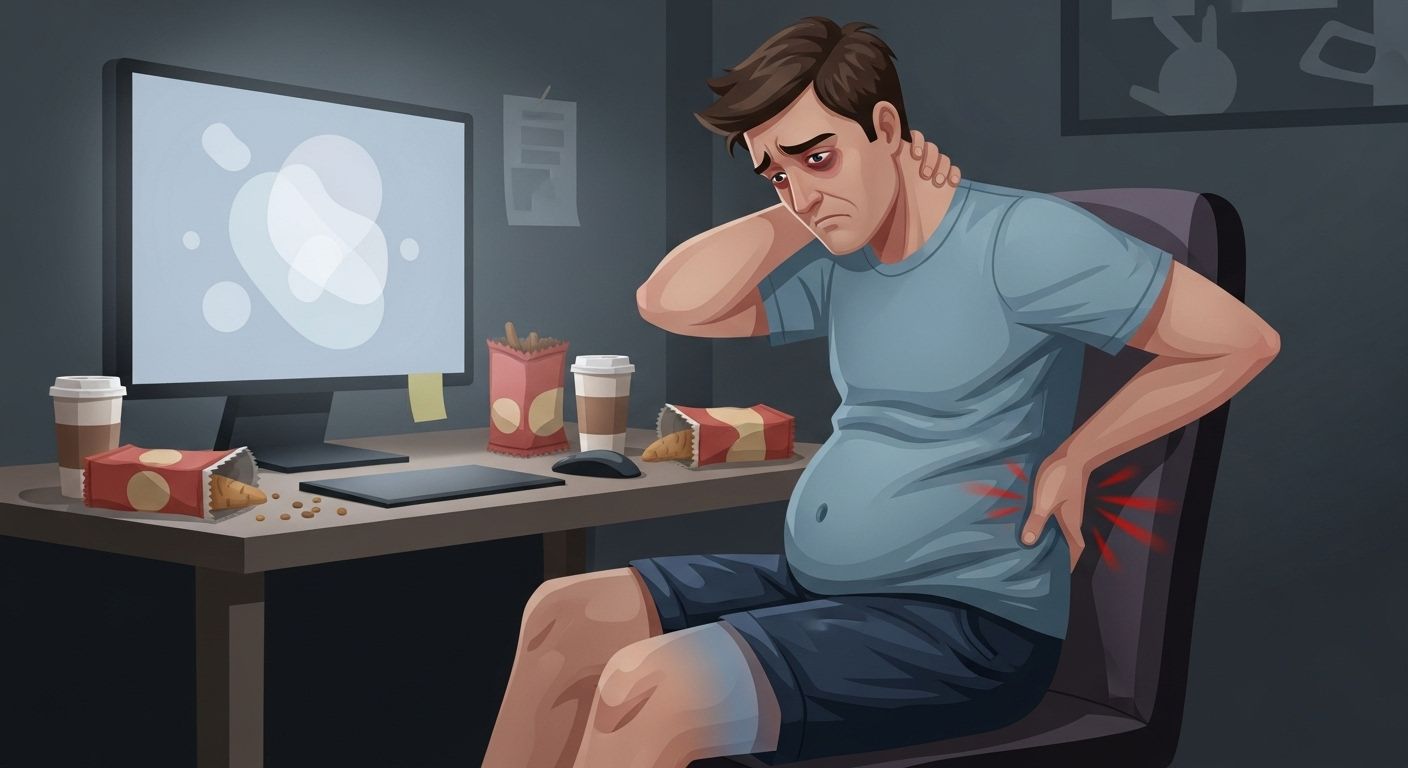
Your spine wasn’t engineered for statue impressions—it thrives on motion. Slouchin’ in that sad desk chair (especially the one with zero lumbar love) forces your spinal discs to take uneven hits, like a tire wearin’ out on one side. Over time? Hello, disc degeneration, herniated discs, or that gnawin’ ache between your shoulder blades like a goblin’s set up camp with a tiny hammer. Toss in “tech neck” from starin’ at screens, and boom—you’ve got tension headaches, stiff traps, and a neck that creaks like an old porch swing. These are straight-up textbook physical symptoms of sitting too much, and they don’t care if your chair cost more than your car—if you ain’t movin’, you’re losin’.

Mood Meltdowns and Mental Fog: The Hidden Emotional Toll
It ain’t just your body that’s payin’ the price—your brain’s takin’ Ls too. Sittin’ all day messes with your happy chemicals like serotonin and dopamine like a DJ skipin’ tracks. Ever finish a 10-hour desk grind feelin’ empty, even though your to-do list is done? That ain’t burnout—it’s your nervous system beggin’ for a walk around the block. Science straight-up links couch-lockin’ lifestyles to higher anxiety, low mood, and that “where’d my focus go?” brain fog. Bottom line? Those physical symptoms of sitting too much leak right into your mental space, creatin’ a loop: feel down → move less → feel worse. Don’t let your sofa become your shrink.
Posture Pandemonium: From Slouch to “Who Even Am I?”
Remember walkin’ into a room like you owned it—shoulders back, head high, feelin’ like the main character? Yeah, your chair stole that. Round shoulders, forward head, and that hunched “I’ve-seen-things” upper back (aka tech neck) ain’t just ugly—they pinch nerves, shrink your lung space, and turn your traps into granite. And over time, your body locks in that slump like it’s your permanent setting. Try to stand tall now, and it feels like liftin’ a Buick. Your posture’s basically shoutin’ to the world, “I gave up on gravity.” These are quiet but mighty physical symptoms of sitting too much, sneakin’ in one remote meeting at a time.
Energy Drain: Why You’re Tired But Can’t Sleep
Here’s the paradox: you’re wiped from doin’ nothin’ all day, yet you’re starin’ at the ceiling at 2 a.m. like your brain’s runnin’ a midnight 5K. Too much sit-time throws your body clock off-kilter and slashes that deep, restorative slow-wave sleep you actually need. Without movement, you never build that sweet, natural fatigue that whispers, “Time to hit the hay.” Add in stiff muscles and poor circulation? Hello, restless legs or those creepy nighttime cramps. So yeah—those physical symptoms of sitting too much include exhaustion that never satisfies and sleep that ghosts you. It’s like your phone’s at 2% and won’t charge no matter what.
Digestive Drama: Your Gut’s Silent Protest
Here’s a hot take nobody’s servin’: sittin’ squishes your gut like a packed lunchbox. Your intestines get compressed, slowing down peristalsis—that smooth, wave-like motion that keeps your plumbing flowin’ like a lazy river. Result? You’re bloated after a salad, constipated like your pipes are on strike, or gettin’ heartburn from a plain turkey sandwich. Ever feel stuffed after lunch just ’cause you didn’t budge from your desk? That’s your gut wavin’ the white flag. These gut grumbles are low-key but legit physical symptoms of sitting too much—especially if your “dining room” is just your keyboard tray.
Breaking Free: Small Moves, Big Shifts Against Sedentary Harm
So what’s the play? You don’t need a gym membership (though hey, if you got one, use it). You just need *movement*, plain and simple. Pop up every 30 minutes like your chair’s on fire. Do a 2-minute kitchen dance party. Take calls walkin’ ’round the block like you’re in a detective flick. Heck—even fidgetin’ counts! Studies show that just 5 minutes of light movin’ every hour can slash those physical symptoms of sitting too much by half. And don’t sleep on strength work—glutes, core, hips—to rebuild what chair-life stole. For more on livin’ your healthiest days, swing by Dr Jay Stone. Dive deeper into wellness with the Health section. And if you’re curious how blood type shapes your body’s stress game, check out this deep dive on O Negative Blood Group Problems: Universal Donor Issues.
Frequently Asked Questions
How can you reverse the effects of sitting all day?
Reversing the physical symptoms of sitting too much starts with consistent micro-movements: stand every 30 minutes, stretch your hip flexors, and activate your glutes with bridges or squats. Daily walks, even short ones, improve circulation and posture. Over time, adding strength training 2–3 times a week rebuilds weakened muscles and restores metabolic balance linked to sedentary strain.
What happens to your legs when you sit too much?
When you sit for extended periods, blood flow to your legs slows, leading to swelling, numbness, or tingling—a condition often called “economy class syndrome.” Chronic inactivity weakens calf and thigh muscles, increases risk of varicose veins, and may contribute to deep vein thrombosis. These are all telltale physical symptoms of sitting too much affecting lower-limb health.
What muscles get weak from sitting too much?
The physical symptoms of sitting too much include significant weakening of the gluteus maximus (hello, dead butt syndrome), abdominal core muscles, and hamstrings. Meanwhile, hip flexors and chest muscles become overly tight, creating muscular imbalances that pull the body out of alignment and contribute to chronic pain.
Why is sitting too long bad for you?
Prolonged sitting disrupts nearly every system in your body. It slows metabolism, impairs circulation, weakens postural muscles, compresses internal organs, and elevates risks for heart disease, diabetes, and even certain cancers. The physical symptoms of sitting too much accumulate silently—until your body forces you to listen through pain, fatigue, or dysfunction.
References
- https://www.cdc.gov/physicalactivity/basics/sitting-and-health.html
- https://www.mayoclinic.org/healthy-lifestyle/adult-health/expert-answers/sitting/faq-20058005
- https://www.health.harvard.edu/blog/too-much-sitting-2018012513904
- https://www.ncbi.nlm.nih.gov/pmc/articles/PMC5439517/